

Recently, a research team led by Prof. Li Sheng and Prof. Shi Zhixiang from the School of Physics at Southeast University published a paper entitled “Pauli-limited upper critical field and anisotropic depairing effect of La2.82Sr0.18Ni2O7 superconducting thin film” in the internationally renowned journal “Materials Today”.
The discovery of the Ruddlesden–Popper (RP) bilayer nickelate superconductor La3Sr0.18Ni2O7 has attracted widespread attention due to its relatively high superconducting transition temperature (Tc) exceeding the liquid-nitrogen temperature range under high pressure. Recently, several independent research groups have successfully realized superconductivity at ambient pressure by growing bilayer RP nickelate thin films on SrLaAlO4 substrates, marking an important milestone in the exploration of unconventional superconductivity in nickelates. Characterizing the upper critical field (Hc2) provides a complementary approach to probing pairing symmetry. As a key parameter, Hc2reflects the pairing strength and dominant depairing mechanisms, and also provides insight into fundamental superconducting properties such as the energy gap, coherence length, anisotropy, and dimensionality.
The team carried out systematic transport measurements on high-quality La2.82Sr0.18Ni2O7 thin films. The results show that the film exhibits typical two-dimensional electronic transport behavior in the normal state, consistent with the two-dimensional variable-range hopping model. In addition, clear crossing features in the magnetoresistance curves at different temperatures were observed, suggesting the possible presence of quantum Griffiths singularity in the system.
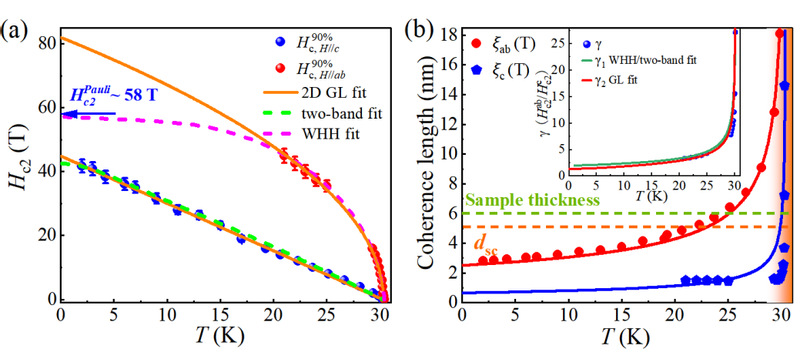
Through systematic measurements of the upper critical field, the temperature dependence of the coherence length along the c-axis was obtained. The results indicate that the nickelate superconducting thin film behaves as a two-dimensional superconductor at high temperatures, gradually evolving into three-dimensional bulk-like superconductivity at low temperatures. The two-dimensional superconducting characteristics at high temperatures mainly originate from superconducting confinement effects.
Further analysis of the upper critical field reveals that the in-plane Hc2 can be well described by the single-band WHH model, while the out-of-plane Hc2is better fitted by a two-band model, both are found to be below the Pauli limit. Moreover, the anisotropy of Hc2is consistent with previously reported bulk nickelate superconductors, thereby clarifying the physical origin of the high upper critical field and strong anisotropy in the thin-film system.
Based on these findings, the authors propose a possible pairing model in nickelate superconductors involving a spin-locking mechanism. These results are consistent with recent experimental and theoretical studies, not only confirming the bulk-like superconducting nature of the thin film, but also providing a new physical picture for understanding unconventional superconductivity in nickelate oxide thin films.
The first author of the paper is Ph.D. student Wang Ke. Prof. Shi Zhixiang and Prof. Li Sheng serve as the corresponding authors, and the School of Physics at Southeast University is the primary affiliation. The samples were provided by the group of Prof. Nie Yuefeng at Nanjing University, and high-field measurements were performed at the National High Magnetic Field Center of Huazhong University of Science and Technology under the guidance of Prof. Zhu Zengwei.
Link: https://doi.org/10.1016/j.mattod.2026.103269
