

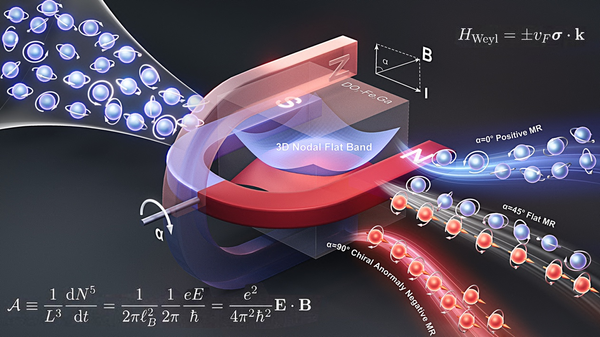
Ideal topological semimetals are particularly fascinating because of their “diode-like” gating effect on chiral electrons. When a magnetic field is aligned parallel to the current, a chiral electron current emerges from the chiral energy bands; when the field is perpendicular, this chiral current is completely switched off. Such behavior can give rise to a range of novel phenomena, positive and negative magnetoresistance, a distinctive planar-longitudinal magnetoresistance, and unconventional Hall effects. Furthermore, recent theoretical studies show that topological nodes formed by nearly flat bands provide an exceptionally high density of states, dramatically amplifying the topological response. Owing to the weak dispersion and strong electronic correlations characteristic of flat bands, this chiral-current gating effect holds great promise for future topological quantum computing. Nevertheless, experimentally discovering and synthesizing high-quality single crystals that host such topological flat bands remains extremely challenging.
Now, a collaborative team led by Associate Professor CHEN Taishi, along with Professors XIA Ke, Ma Liang, and WANG Jinlan from the School of Physics at Southeast University, has achieved a breakthrough in tackling this challenge. Using the chemical vapor transport method, they successfully grew high-quality D0₃-Fe₃Ga bulk single crystals. Magnetotransport measurements clearly resolved a positive magnetoresistance when the magnetic field was perpendicular to the current, and a negative magnetoresistance when the field was parallel,the hallmark chiral anomaly. More strikingly, the team observed for the first time a robust flat magnetoresistance effect with the magnetic field oriented at 45° to the current; this effect remained entirely undiminished even under an extreme magnetic field of 33 T. Theoretical calculations reveal that the nodal web near the Fermi level collapses into Weyl points with pronounced tilting under spin–orbit coupling, thereby dictating the topological transport behavior.Besides, analysis based on the Kadowaki–Woods ratio further demonstrates that the electronic correlation strength of the D0₃-Fe₃Ga single crystal along the (111) direction is nearly an order of magnitude larger than that of conventional correlated metals (Fe, Re, Os, Pd, Ni, Pt), and that the system exhibits clear non-Fermi liquid behavior at ultralow temperatures. Moreover, compared with single crystals previously grown by the Czochralski method (Nature 581, 53, 2020), this study reveals that the topological properties of D0₃-Fe₃Ga can be tuned by applying strain. These findings are pivotal both for fundamental research in correlated topological physics and for the development of advanced topological quantum devices. The work was published in Nature Communications on May 26, 2026, entitled“Robust flat-magnetoresistivity in D0₃-Fe₃Ga driven by chiral anomaly”.
Link:https://www.nature.com/articles/s41467-026-73748-z
